Evidence
Peer-reviewed benchmarks, health-authority ground-truth evaluations, and practitioner data.
Benchmarks
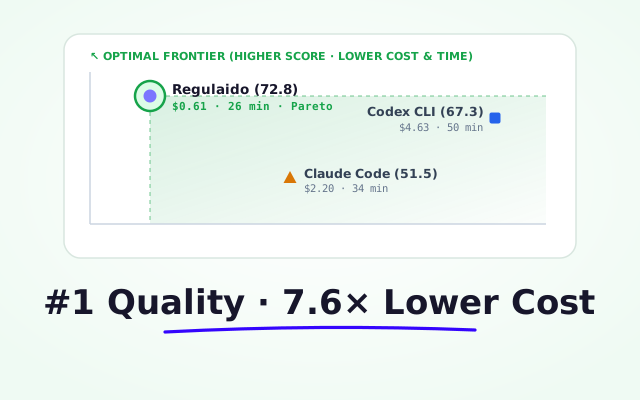 ISPOR Europe 2026 · Poster HTA86 View results ↓
HTA-Bench: End-to-End HTA Dossier Generation
Pareto-optimal across quality, speed, and cost against frontier agent harnesses (OpenAI Codex CLI and Anthropic Claude Code) on end-to-end AMNOG & EU HTA dossier authoring.
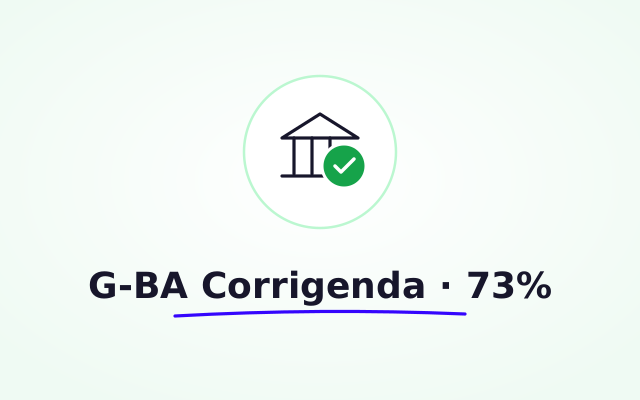 G-BA Corrigenda Ground Truth (2016–2026) View results ↓
G-BA Corrigenda Audit: Pre-Submission QC vs. Official Corrections
Tested blindly on pre-correction submission bundles across 1,336 § 35a procedures where the G-BA later issued an official correction decree (sachlich-rechnerische Richtigstellung).
Conferences & posters
 Poster HTA86 Poster MSR212
 Regulatory AI Posters HTA53 & HTA227
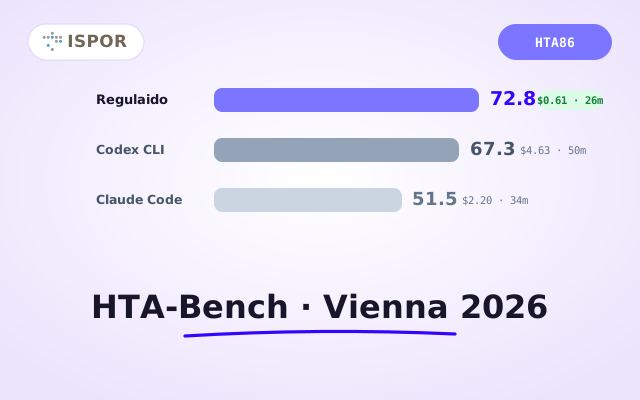 To be presented at ISPOR Europe 2026 · Vienna (Nov 8–11 · Poster HTA86) Details & abstract ↓
HTA-Bench: A Human-Validated Benchmark for AI Generation of European HTA and Market-Access Documents
Introduces HTA-Bench, an expert-grounded benchmark evaluating end-to-end AI generation of authentic German AMNOG and European HTA deliverables in Word templates. Regulaido achieves the Pareto-optimal #1 aggregate score of 72.8 (outperforming OpenAI Codex CLI at 67.3 and Anthropic Claude Code at 51.5) while completing runs in 26 minutes (vs. 50 min and 34 min) at $0.61 per run (7.6× lower cost than Codex CLI at $4.63 and 3.6× lower than Claude Code at $2.20).
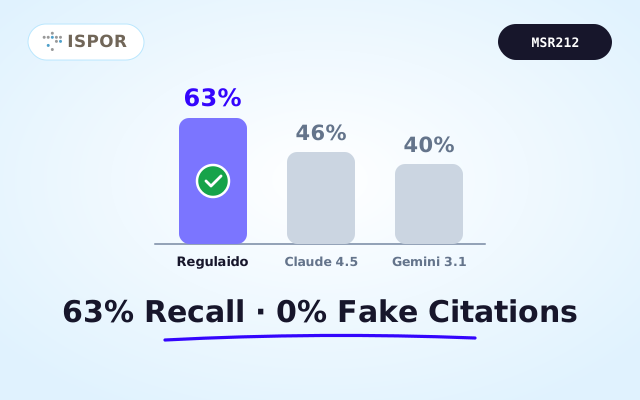 Presented at ISPOR 2026 · Philadelphia (May 2026 · Poster MSR212) Details & abstract ↓
General-Purpose Versus Domain-Specific AI for Systematic Confounder Identification in Multiple Sclerosis: A Comparative Methodological Study Using IQWiG Assessments as Ground Truth
Benchmarked against IQWiG working paper GA23-02 (132 confounder variables, 62 person-days manual effort), Regulaido achieved the deepest granular recall (63%, 83/132 variables) with 0% citation fabrication in under 5 minutes—outperforming general-purpose frontier LLMs (Claude Opus 4.5 at 45–46% and Gemini 3.1 Pro at 29–40%, which exhibited up to 36–40% DOI fabrication without corpus constraints).
 Presented at ISPOR Europe 2025 · Glasgow (Poster HTA53) Details & abstract ↓
Beyond Productivity: How Professional Identity Shapes Generative AI Adoption Among Medical Writing Professionals
Survey of 27 medical writers shows Perceived Usefulness is the only significant driver of AI adoption (β=0.522, p=0.028), while trust in AI does not predict professional identity threat (β=-0.032, p=0.901). With 96% using Regulaido and strong regulatory compliance confidence (M=6.22/7), successful GenAI integration depends on clear regulatory guidance and hybrid workflows that preserve strategic judgment while leveraging AI for routine tasks.
 Presented at ISPOR Europe 2025 · Glasgow (Poster HTA227) Details & abstract ↓
Mapping Writer-AI Conversations for HTA: An Analysis of 12,500 Messages
Analysis of 12,500 messages from 32 HTA writers revealed that AI assistants function as specialized toolboxes—primarily used for Information Extraction & Retrieval (27.2%) and Text Generation & Drafting (17.2%), focusing on Clinical Study Documentation (22.5%). User engagement follows intermittent, project-based patterns rather than daily use, suggesting AI tools should prioritize task-specific interfaces over generic chat functionality.
Practitioner survey
How practitioners describe Regulaido
“Our internal AI that helps us concentrate on strategic aspects of a project while it handles all the "Fleißarbeit" that needs to be done.”
Measurable capacity gains across the writing team.
Usage Frequency
Q4 · HabitTime Saved Per Day
Q7 · Direct impactBlog
AI in JCA dossiers: the EU's new rules, explained
The HTA Coordination Group now expects AI use in JCA dossiers to be documented, versioned and disclosed, down to the individual prompt. We explain the new principles and how Regulaido supports compliance.
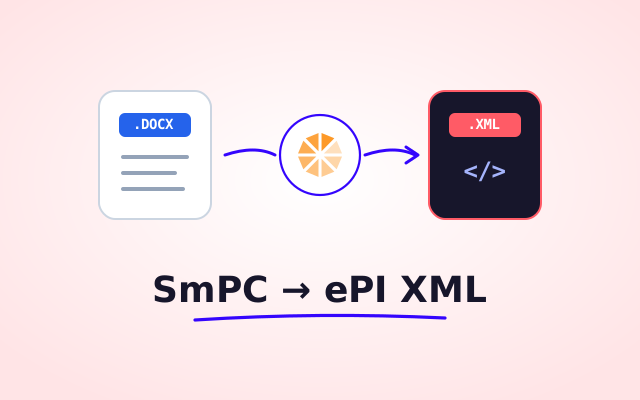
From SmPC to ePI in One Prompt
Converting an approved EMA SmPC into a complete FHIR ePI XML Bundle in a single Regulaido workflow, with blind review by regulatory affairs specialists.
Guides & playbooks
AI in JCA Dossiers Compliance Guide
How to document prompts, model versions, and human verification under the HTACG principles.
SmPC to ePI XML Blueprint
Step-by-step architecture for converting approved Word SmPCs into validated EMA FHIR XML bundles.
Audit-Ready Literature Screening
Setting PICO criteria, dual-stage abstract/full-text screening, and traceable table extraction.
See Regulaido on your own documents.
Bring an SLR protocol, a house Word template, or a dossier section. In 30 minutes we will run it live and answer your questions on workflows, EU hosting, and rollout.
“Tell me which dossier, literature review, or Word template is eating your team’s week. We’ll test it live together.”